A direct booking website lets guests reserve your vacation rental with you rather than through an online travel agency (OTA), such as Airbnb or Vrbo. You control the checkout and guest relationship, but you also take on the work the platform handled. That trade can improve your margins. It can also leave you paying for a website that nobody visits. The right starting question is: which guests will book here, and what will each reservation actually save?
Airbnb Universe is a host-run blog about Airbnb hosting, created by Devin and Sarah. Their basement suite attracted poor results on standard rental websites before their switch to Airbnb brought a first booking within hours. Their hosting story offers a useful reminder for this decision: a property needs distribution, not just a place online. Your own website has to earn its traffic too.
What should your direct booking website do?
A pretty homepage doesn’t necessarily sell a stay. Say a guest finds your lake cabin on their phone, likes the porch, and then can’t tell whether the dates are available. They’ll probably leave before emailing you. Your website needs to answer the booking questions while the guest is still interested.
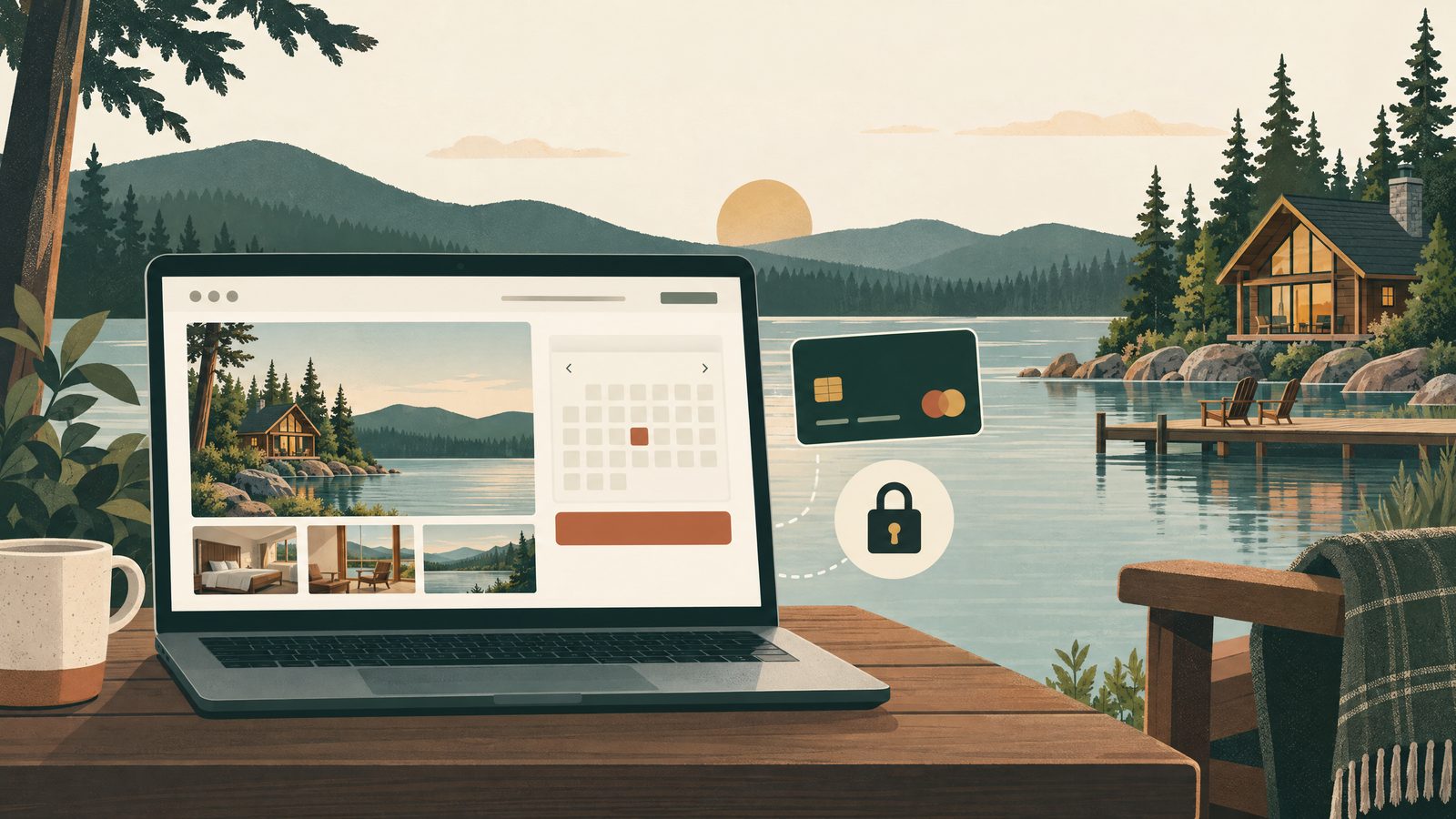
The minimum useful version shows the property accurately, lets visitors check dates and the full price, explains the terms, and provides a secure way to reserve. It should identify the person or business taking the booking. A contact form alone can work for an inquiry-first launch, but label it clearly: sending an inquiry doesn’t reserve dates.
Direct bookings don’t have to replace OTAs. For a single-property host, a mixed approach often makes more sense: platforms bring travelers who don’t know you, while your website serves guests who already have a reason to trust you. Those might be returning visitors, referrals, or people looking for a particular neighborhood and amenity.
Before choosing software, write down your first audience and your expected annual direct reservations. Put the costs and responsibilities in your Airbnb business plan. If the audience is merely “everyone searching for vacation rentals,” you haven’t identified a workable acquisition route yet. Start narrower.
Does booking direct really save money?
“Commission-free” can hide an expensive reservation. Say you give a returning guest a discount, pay card processing, and spend an evening answering questions. The platform fee disappears, but those costs don’t. Compare the amount you keep after distribution costs, rather than the fee advertised by either channel.
Use the host-side fee from your own reservation statement. Airbnb fee structures can differ between accounts and setups; don’t assume a rate from another host’s screenshot. If a platform adds a separate guest fee, that wasn’t your revenue. Removing it may make your direct offer attractive without requiring you to cut your own price.
A worked comparison for one four-night stay
A blanket discount can erase the savings on a lower-fee listing. To see why, say a US lake cabin rents for four nights at $200 per night, with a $100 cleaning charge. Compare two hypothetical OTA host-fee scenarios, 3% and 15%, against a direct offer.
These are modeling assumptions, not current Airbnb or Vrbo rates. Assume each OTA fee includes its payment handling, applies to the lodging-plus-cleaning subtotal, and has no other host-side charges. Replace these inputs with your actual settlement details.
For the direct reservation, assume:
- A 5% discount on lodging only, with the cleaning charge unchanged.
- An illustrative 10% lodging tax on lodging plus cleaning, collected from the guest. This isn’t a quoted jurisdiction’s tax rate.
- Payment processing of 3% plus $0.30 on the full tax-inclusive payment, with one card transaction.
- A $20 allowance per reservation for marketing, extra administration, and dispute risk. Your actual allowance may be higher.
| Booking calculation | OTA: assumed 3% host fee | OTA: assumed 15% host fee | Direct booking |
|---|---|---|---|
| Lodging charge | $800.00 | $800.00 | $760.00 |
| Cleaning charge | $100.00 | $100.00 | $100.00 |
| Subtotal before tax | $900.00 | $900.00 | $860.00 |
| Host platform fee | $27.00 | $135.00 | $0.00 |
| Direct card processing | Included above | Included above | $28.68 |
| Direct variable-cost allowance | Not modeled | Not modeled | $20.00 |
| Retained after modeled distribution costs, excluding tax | $873.00 | $765.00 | $811.32 |
Here’s the direct calculation once: lodging is 4 × $200 = $800; the discount is $800 × 5% = $40. The discounted lodging plus cleaning is $760 + $100 = $860. Tax adds $86, so the guest pays $946. Processing is $946 × 3% + $0.30 = $28.68. After setting aside tax and the $20 allowance, you retain $860 − $28.68 − $20 = $811.32.
That is $46.32 more than the higher-fee OTA case, but $61.68 less than the lower-fee case. Direct isn’t automatically cheaper for the host.
These amounts aren’t profit. You still pay the cleaner, utilities, insurance, and other operating costs. Those costs are assumed equal across channels here. OTA guest fees, where applicable, aren’t included in the table because they aren’t host receipts. Actual taxable amounts and processing rules also vary.
Turn the booking calculation into a yearly decision
One profitable direct reservation doesn’t prove the website pays for itself. Say your annual site, domain, and incremental software budget is $480. At the modeled $46.32 gain, $480 ÷ $46.32 means you need 11 comparable reservations shifted from the higher-fee channel to cover that annual budget.
That’s before any separate first-year setup expense. Include purchased design work and a value for your setup time when assessing year one. Count only costs added by the direct channel; don’t charge it for software you’d already use anyway.
For a genuinely additional booking on an otherwise empty night, use a different comparison: revenue minus its added operating and acquisition costs. It isn’t an OTA fee saving if no OTA guest would’ve booked those dates. This distinction helps you decide whether to promote orphan nights, the short gaps between reservations, or discount a weekend likely to sell without help.
Your Airbnb pricing strategy should therefore set a direct-rate floor, rather than applying a permanent percentage discount. Protect the margin first. Offer better value only where the numbers leave room.
Choose a domain you own and a site you can maintain
A host can lose control of their booking channel before the first reservation. Say a designer registers your domain in their own account, then stops answering emails. Changing builders becomes harder because the address belongs to someone else. Keep domain ownership separate from whoever builds the pages.
Choose a short, pronounceable property or business name that guests can type after hearing it aloud. Avoid a long string of destination keywords. And don’t name the site as though it’s an official Airbnb service. Your domain should identify your business, not borrow a platform’s identity.
Register it in an account you control, enable multifactor authentication, and keep renewal and recovery details current. Use a domain-based contact email where practical. Make sure your website builder can connect your domain and that you can export guest records and reservation data if you leave.
There are several sensible building routes:
Booking software with an included website suits hosts who want fewer moving parts. Check whether the required plan includes a booking engine, taxes, payment schedules, and the channel connections you need. A low headline subscription isn’t the whole cost.
A general website builder with an embedded booking engine gives more control over presentation. But you’ll need to test the connection between the pages and checkout, including what happens when the booking tool fails to load.
A self-managed site or custom build offers greater control but adds updates, backups, and security work. It can make sense for a portfolio with specific needs. It’s rarely the first job a busy single-cabin host should give themselves.
Ask for a complete cost schedule, including booking commissions, transaction charges, add-ons, and support. Then test the guest journey, rather than choosing from a feature checklist. Can you change a cancellation deadline without calling a developer? That’s a useful question.
Build pages that answer the guest’s actual objections
Guests hesitate over details that hosts barely notice. Say a family likes your two-bedroom condo but can’t find out whether the second bedroom has a door or whether parking fits their vehicle. More promotional copy won’t resolve that uncertainty. Specific information will.
For one property, you don’t need a large site. A homepage can introduce the stay and lead to a detailed property page, with separate booking, contact, and policy pages where helpful. Multiple properties need individual pages and filters that match how guests choose between them.
The property page should show sleeping arrangements, bathrooms, occupancy limits, parking, pet terms, and location context. Name the amenities precisely: a desk in a bedroom isn’t the same as a separate office. Explain stairs, shared spaces, road access, and any seasonal restrictions before a guest commits.
Use current photography that includes the less glamorous practical details. A driveway photograph may settle a question that a sunset photograph can’t. Our Airbnb photo guide can help you plan coverage, while the advice on writing a useful listing description applies equally to your own property page.
Keep the booking button visible on mobile without covering the text. Compress photo files, avoid unnecessary animation, and test the calendar on a small screen. Don’t require an account just to see a price unless your booking system genuinely needs one.
Accessibility belongs in this first build. The Department of Justice’s 2022 web-accessibility guidance identifies barriers such as poor contrast, unlabeled forms, missing image descriptions, and mouse-only controls. Choose a booking engine that supports keyboard use and clear error messages. Legal coverage depends on your operation; ask a qualified adviser about your obligations rather than assuming every rental has identical requirements.
Set up payments and policies before accepting reservations
The first direct payment exposes gaps an OTA used to fill. Say a guest pays a deposit, asks to cancel, and your site never explained when the balance becomes due. You now have an argument about money instead of a clear process. Write the rules and configure checkout together.
Make checkout secure and predictable
An email saying “send your card number” puts both parties in an awkward position. Use a reputable processor through a hosted checkout or properly integrated booking engine instead. Avoid collecting card numbers in forms, messages, or spreadsheets; ask the payment provider which security and compliance duties remain yours.
Decide whether payment is collected in full or in scheduled installments. Show the amounts, due dates, refund treatment, and any authorization requirements before purchase. A reservation deposit and a damage-deposit authorization serve different purposes; don’t label both just “deposit.” Check whether a temporary card hold lasts long enough for your planned process.
Before launch, test a successful payment, a declined payment, a cancellation, and a refund. Check the confirmation email and the name guests see on their card statement. An unfamiliar billing name can prompt a dispute even when the stay was genuine.
Keep enough cash available for refunds and possible disputes. A payment isn’t guaranteed to remain yours because the guest clicked an agreement. Retain the accepted terms, payment records, relevant messages, and evidence of the stay, and follow the processor’s dispute procedure.
Publish the total price and the cancellation terms
A cheap nightly rate followed by unavoidable charges can mislead a guest. For example, a mandatory cleaning fee added only at the last checkout screen changes the price after they’ve invested time in choosing your property. Display the required charges upfront.
The FTC’s May 2025 guidance on unfair or deceptive fees explains the rule effective May 12, 2025. It covers short-term lodging, including vacation rentals. Advertised total prices must include mandatory fees such as cleaning, with the total more prominent than itemized pricing. Taxes and certain other permitted charges may be disclosed later, but excluded charges and the final payment amount must be shown before asking for payment.
For selected dates, show the stay total and its breakdown. Don’t rely on an asterisk beside a nightly rate to carry the explanation.
Your terms should state cancellation deadlines with the property’s time zone, what gets refunded, and what happens to installments. Address pets, occupancy, minimum booking age where lawful, smoking, and damage procedures. Use the house-rules guide as a starting point, but have the direct rental agreement reviewed for your jurisdiction. Record acceptance and preserve the version accepted.
Give taxes and insurance a separate check
A host may assume that taxes are handled because Airbnb collects some taxes on platform reservations. Say the same property then takes payment through its own website. That payment route needs its own tax review; the platform’s collection arrangement doesn’t automatically follow it.
The University of North Carolina School of Government’s 2022 occupancy-tax explanation states that North Carolina owners remain responsible for occupancy taxes on rentals for which they collect payment directly. That’s a state-specific example, not a nationwide rulebook.
Check your state revenue department and local tax office for registrations, taxable charges, filing frequency, and exemptions. Confirm who actually remits tax if your software offers tax tools. Calculation isn’t remittance. Keep tax money separate from spendable receipts, and reconcile reservations against payments and filings.
Also confirm that your permits, lease or HOA rules, and insurance allow direct rentals. Ask your insurer about liability, property damage, and the booking channels covered. Don’t assume platform-related protections extend to an off-platform stay.
Replace platform familiarity with evidence guests can check
A stranger may distrust a direct site even when its price is lower. Say they’ve seen your cabin photos elsewhere and wonder whether your payment page is an imitation. A lock icon won’t answer who operates the rental. Give them a way to verify the business and reach a person.
Use consistent property naming, an honest host introduction, a working phone number, and an email address you monitor. Show relevant registration details where required. Explain the general location publicly and how confirmed guests receive the exact address and arrival information. You don’t need to publish door codes to demonstrate legitimacy.
Reviews help when their origin is clear. Ask permission before publishing a guest’s testimonial, keep its meaning intact, and label its source and date. Don’t imply that testimonials selected for your website form an independently audited review score. The Airbnb reviews guide provides useful context for treating feedback as evidence rather than decoration.
Show the inconvenient details too: the steep driveway, neighboring unit, or lack of air conditioning. Guests trust accurate limitations more than a page that claims every traveler will love the property.
And make support concrete. Give realistic response hours, explain urgent contact arrangements, and say how guests can raise a problem. A clear cancellation policy and recognizable payment process can matter more than a row of badges you haven’t earned.
Start with past guests without misusing their contact details
A new website rarely arrives with an audience. Say a couple loved your cabin last fall but can’t remember its name when planning another trip. Giving them a legitimate way to find you again is more realistic than immediately paying to reach strangers.
Respect the platform’s current communication and off-platform rules. Don’t divert an active OTA inquiry or reservation to your own checkout, pressure guests to cancel, or treat contact information supplied for a stay as permission to market indefinitely. A direct channel should be built independently, not by breaking the rules of another channel.
Where permitted, offer an optional signup through your own site or guest materials. Explain what they’ll receive and keep marketing consent separate from information needed to manage a booking. Your welcome book can explain how guests may hear about future availability, provided that use complies with platform rules and applicable law.
The FTC’s CAN-SPAM business guide, published in 2023, requires truthful sender and subject information, appropriate advertising identification, a valid postal address, and an easy opt-out for commercial emails. Opt-out requests must be honored within 10 business days. Permission-based signup is the recommended approach here, not a claim that CAN-SPAM always requires prior consent. Other laws may apply too.
Send something useful: dates for the season they usually visit, a genuine property improvement, or availability matching a stated preference. Keep booking confirmations separate from promotions. You don’t need a weekly newsletter about the same porch.
Use local SEO and social to attract suitable stays
Broad traffic can be an expensive distraction. Say your pet-friendly cabin ranks for a general hiking question, but most readers are locals looking for an afternoon walk. They may never need accommodation. Build content around searches with a believable connection to a stay.
For local search engine optimization (SEO), give each property page a descriptive title containing its actual location and property type. Explain nearby destinations, realistic travel times, and features that help guests choose. A page about staying near a wedding venue can be useful if you genuinely serve its guests; dozens of nearly identical town pages aren’t a substitute.
Make sure important descriptions and property details are readable as web text, not available only inside photographs or a booking widget. Use clear page addresses, submit a sitemap, and keep the site crawlable. Search visibility isn’t guaranteed, and it won’t necessarily arrive by your next empty weekend.
Seek legitimate mentions from relevant tourism organizations, local partners, and destination resources where your rental qualifies. Check eligibility before creating any map or business-directory profile. Don’t assume a standalone vacation rental qualifies for every business listing, and don’t invent a staffed office to get one.
Social content should help someone picture using the property. Show where the dog can sleep, how the kitchen works for a family meal, or what arrival looks like after dark. Link to the relevant property page, rather than making every visitor search from the homepage. Verify advertised availability before posting it.
Measure completed reservations and retained income, not likes. Add campaign tags to your own links so you can distinguish email, partner, and social visits. Ask guests how they found you; that can reveal referrals analytics missed.
Paid advertising comes later. Set an acquisition-cost ceiling from the booking economics, and include agency or management costs. Our vacation rental marketing guide can help you choose channels without treating every new account as another required chore.
Launch with a booking test, not a design reveal
A direct website can look finished while its operations are broken. Say a guest books two nights, but the cleaner never receives the turnover notice and the OTA calendar still shows availability. The reservation needs to reach every part of your hosting workflow.
Choose one master reservation system and document how every channel updates it. Ask what the connection carries: availability, rates, minimum stays, or only blocked dates. Calendar-file feeds can lag; don’t assume every sync method prevents simultaneous bookings. If your setup can’t reliably support instant confirmation across channels, consider request-to-book while you improve it.
Before inviting guests, test this complete chain:
- The chosen dates produce the correct total and enforce minimum stays.
- A confirmed reservation blocks those dates on every connected channel.
- The guest receives the accepted terms, payment receipt, and support details.
- The cleaner or cohost receives the right turnover information.
- A cancellation updates the calendar and follows the promised refund process.
Use the booking software’s test environment where available, and follow processor rules if a real transaction is necessary. Test with a phone and a keyboard too. A desktop preview isn’t enough.
After launch, review failed checkouts and unanswered inquiries alongside confirmed bookings. If visitors repeatedly ask about parking, fix the page. If they reach payment and stop, check total-price presentation and payment errors before redesigning the logo.
When a direct website isn’t worth the work
Some properties have no dependable route to profitable direct demand. Say you host one summer each year, have little repeat business, and already spend your spare hours managing turnovers. A custom website plus advertising may cost more than the fees it removes.
Wait if you can’t maintain reliable availability, handle refunds, or explain who remits taxes. Likewise, fix an inconsistent guest experience before building a retention channel. A difficult first stay won’t become repeat business because there’s a newsletter signup.
Look for a positive gain on bookings shifted from OTAs and a plausible number of reservations to cover fixed costs. The lower-fee scenario above fails as a fee-saving strategy before annual expenses are counted. Shifting more bookings under those same assumptions won’t repair that loss; change the offer or acquisition costs first.
A modest inquiry site may be enough to test independent demand, although it still needs accurate pricing and a workable reservation process. Keep OTA distribution while measuring the result. You don’t need to make your business more complicated to prove you’re serious about hosting.
Build for profitable repeat stays, then expand
A host who launches every feature at once can spend months building before learning whether anyone wants to book directly. Start with one accurate property page, dependable reservation handling, clear terms, and a lawful way for interested guests to return.
Then compare retained income across comparable stays. Count your time, refunds, and acquisition costs alongside the fee savings. If the channel pays its way and guests can use it confidently, expand the traffic work. Your direct booking website earns its place by producing profitable reservations—not by existing.
Frequently asked questions
Do I need a separate direct booking website for each property?
Usually, one business website can serve several properties, with a dedicated page and accurate availability for each rental. Separate domains may be useful for unrelated brands, but they also multiply maintenance and marketing work. Choose the structure that helps guests compare appropriate options and lets you manage reservations from a dependable shared system.
Can I take direct bookings before adding instant checkout?
Yes. An inquiry-based site can collect requested dates while you confirm availability and send a documented offer through your booking system. Make clear that the initial form is a request, not a confirmed reservation. Before collecting money, provide the full payment amount, applicable terms, and a secure payment route.
Does a direct booking price have to be lower than my Airbnb price?
No. Your offer can compete through clear pricing, responsive service, or a practical benefit rather than a discount. Check any rate commitments in your distribution agreements, then compare comparable stays after processing and acquisition costs. If a discount would eliminate your margin, a lower price isn’t a sensible reason to build the channel.
How can I tell whether website visitors are turning into useful bookings?
Track the path from property-page visits to date searches, checkout attempts, and confirmed reservations. Then connect those bookings to their traffic source and retained income. A channel sending fewer visitors may still be more valuable if those guests book suitable dates at a healthy margin. Avoid judging success by traffic alone.